
TOM · The Owner's Manual · Old Testament

1 Chronicles 1

Before you read 1 Chronicles: who, when, why

BOOK 13 OF 66 · OLD TESTAMENT · HISTORY

The Director's Cut

AUTHOR
The book does not name its author. Jewish tradition in the Talmud says Ezra wrote most of Chronicles and Nehemiah finished it. Many scholars think a priest or Levite in Jerusalem, often called the Chronicler, wrote it after the exile from older records the book names, like the records of Samuel, Nathan and Gad, 29:29.
EVENTS TOOK PLACE
The family trees run from Adam to the families back from Babylon. The story itself covers about 40 years, from Saul's death, about 1010 BC, to David's death, about 970 BC.
DATE
About 450 BC if Ezra wrote it, as tradition says. Many scholars say about 400 to 250 BC, because the family line in 3:17 to 24 runs several generations past Zerubbabel.
WRITTEN TO
The Jews back home after the exile, rebuilding the temple and wondering if God's promises to David still stood.
KEY VERSE
1 Chronicles 17:14. But I will set him over My house and My kingdom forever, and his throne will be established forever.
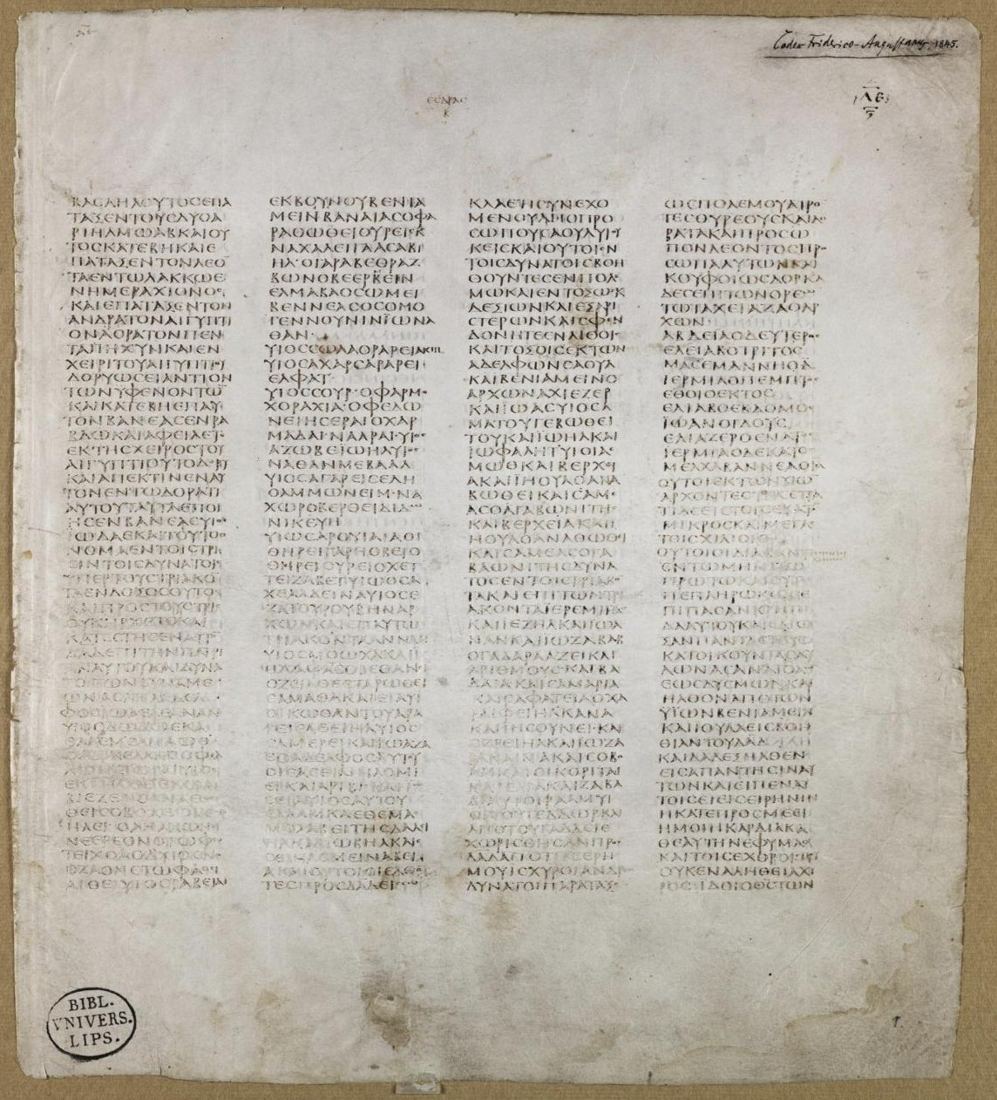
ONE OF THE OLDEST COPIES OF 1 CHRONICLES

One of the Oldest Copies of 1 Chronicles

This page of Codex Sinaiticus, a Greek Bible copied about 330 to 360 AD, holds 1 Chronicles 11:22 to 12:18. Its first column tells how Benaiah killed the huge Egyptian. This leaf is kept in Leipzig, Germany. No Dead Sea Scroll of 1 Chronicles has been found. The only scroll that may be Chronicles, 4Q118, holds a few lines of 2 Chronicles 28 to 29. You may hear the scrolls hold every book but Esther. That counts 1 and 2 Chronicles as one book, as the Hebrew Bible does. So the oldest copies of 1 Chronicles are Greek: Codex Vaticanus, 300s AD, with the whole book, and Codex Sinaiticus, with 9:27 to 19:17. The oldest complete Hebrew copies are the Aleppo Codex, about 930 AD, and the Leningrad Codex, 1008 AD. Photo Leipzig University Library, Cod. gr. 1, Codex Sinaiticus Project.

The Setting

Most of the story happens in Jerusalem. David is made king at Hebron, takes Jerusalem, and brings the ark from Kiriath jearim. The tabernacle and the old altar stand at Gibeon. The last chapters center on Ornan's threshing floor on the hill north of the City of David, where the temple will be built.

What Was Going Wrong

  • Unfaithful Kings And Tribes. Saul died because he was unfaithful and asked a medium instead of God (10:13 to 14). The tribes east of the Jordan chased other gods and were carried off to Assyria (5:25 to 26).
  • The Ark the Wrong Way. David moved God's ark on a new cart instead of on the Levites' shoulders, and Uzzah died (13:9 to 10, 15:13).
  • David'S Census. Satan stirred up David to count the army, and 70,000 died in the plague that followed (21:1 to 14).

Where to Find Jesus

  • 1 Chronicles 1 to 3. The family line runs from Adam to David and on to Zerubbabel. Matthew 1 and Luke 3 follow these names to Jesus.
  • 1 Chronicles 17:11 to 14. God promised a son of David whose throne would last forever. The angel told Mary that Jesus would reign over the house of Jacob forever, Luke 1:32 to 33, and Hebrews 1:5 applies I will be His Father to Jesus.
  • 1 Chronicles 24:10. David set up the priests' groups. Zechariah served in Abijah's group when the angel told him his son John would prepare the way for Jesus, Luke 1:5.

Cool Stuff Most People Miss

  • One Book, the Last Book. In the Hebrew Bible, 1 and 2 Chronicles are one book, Divrei Hayamim, the words of the days. It is the last book in printed Hebrew Bibles and in the Talmud's list, though the two oldest full Hebrew Bibles, the Aleppo and Leningrad codices, put it first in the Writings. Jesus spoke of the blood of Abel to the blood of Zechariah, Luke 11:51. Many think He meant the first and last murders in that order, 2 Chronicles 24:21. The Greek Bible split it in two and called it Paraleipomenon, the things left out. Jerome called it a chronicle of the whole sacred history, and the name Chronicles stuck.
  • The Director'S Cut. Chronicles leaves out Bathsheba, Absalom and most of Saul, and adds the family trees, the Levites, the singers, the prayer of Jabez and David's plans for the temple. See the Big Question pages Chronicles vs Samuel and Kings.

How Did It Turn Out?

David died old and full of days, and Solomon sat on the throne with the land bought, the gold gathered and the plans in hand, 29:26 to 28. The story goes on in 2 Chronicles with the temple, and the promise of a son of David on the throne forever came true in Jesus.

Chapter 1 in 30 seconds

The book opens with the longest family tree in the Bible: Adam, Seth, Enosh, and on and on. Noah's sons fill the world, Abraham has sons, Isaac has sons, and the kings of Edom get their turn too. If you ever wanted to know who Jobab's dad was, this is your chapter.

Tap a color to hide it

From Adam to Abraham// Genesis 5:1–32; Genesis 10:1–32; Genesis 11:10–26

1Adam, Seth, Enosh,

  • 1CH 1:1[ALLUDED TO]The New Testament refers to this → LK 3:31-38
  • 1CH 1:1[NOTE]ADAM TO DAVID. The book starts with the first man and walks down the generations to David, the line Jesus came from, Luke 3:38. See the Big Question pages Why So Many Names?

2Kenan, Mahalalel, Jared,

3Enoch, Methuselah, Lamech, Noah.

4The sons of Noah:

Shem, Ham, and Japheth.

5The sons of Japheth: Gomer, Magog, Madai, Javan, Tubal, Meshech, and Tiras. 6The sons of Gomer: Ashkenaz, Riphath, and Togarmah. 7And the sons of Javan: Elishah, Tarshish, the Kittites, and the Rodanites.

8The sons of Ham: Cush, Mizraim, Put, and Canaan. 9The sons of Cush: Seba, Havilah, Sabta, Raamah, and Sabteca. The sons of Raamah: Sheba and Dedan. 10Cush was the father of Nimrod, who began to be a mighty one on the earth. 11Mizraim was the father of the Ludites, the Anamites, the Lehabites, the Naphtuhites, 12the Pathrusites, the Casluhites (from whom the Philistines came), and the Caphtorites. 13And Canaan was the father of Sidon his firstborn, and of the Hittites, 14the Jebusites, the Amorites, the Girgashites, 15the Hivites, the Arkites, the Sinites, 16the Arvadites, the Zemarites, and the Hamathites.

17The sons of Shem: Elam, Asshur, Arphaxad, Lud, and Aram. The sons of Aram: Uz, Hul, Gether, and Meshech. 18Arphaxad was the father of Shelah, and Shelah was the father of Eber. 19Two sons were born to Eber: One was named Peleg, because in his days the earth was divided, and his brother was named Joktan. 20And Joktan was the father of Almodad, Sheleph, Hazarmaveth, Jerah, 21Hadoram, Uzal, Diklah, 22Obal, Abimael, Sheba, 23Ophir, Havilah, and Jobab. All these were sons of Joktan. 24So from Shem came Arphaxad, Shelah, 25Eber, Peleg, Reu, 26Serug, Nahor, Terah, 27and Abram (that is, Abraham).

  • 1CH 1:24[ALLUDED TO]The New Testament refers to this → LK 3:31-38

The Descendants of Abraham// Genesis 25:12–18

28The sons of Abraham were Isaac and Ishmael. 29These are their genealogies:

Nebaioth the firstborn of Ishmael, then Kedar, Adbeel, Mibsam, 30Mishma, Dumah, Massa, Hadad, Tema, 31Jetur, Naphish, and Kedemah. These were the sons of Ishmael.

32The sons born to Keturah, Abraham’s concubine: Zimran, Jokshan, Medan, Midian, Ishbak, and Shuah.

The sons of Jokshan: Sheba and Dedan.

33The sons of Midian: Ephah, Epher, Hanoch, Abida, and Eldaah. All of these were Keturah’s sons.

34Abraham was the father of Isaac. The sons of Isaac: Esau and Israel.

  • 1CH 1:34[ALLUDED TO]The New Testament refers to this → MT 1:2-12
  • 1CH 1:34[ALLUDED TO]The New Testament refers to this → LK 3:31-38

The Descendants of Esau// Genesis 36:1–19

35The sons of Esau: Eliphaz, Reuel, Jeush, Jalam, and Korah. 36The sons of Eliphaz: Teman, Omar, Zepho, Gatam, and Kenaz; and by Timna, Amalek. 37The sons of Reuel: Nahath, Zerah, Shammah, and Mizzah.

The Descendants of Seir// Genesis 36:20–30

38The sons of Seir:

Lotan, Shobal, Zibeon, Anah, Dishon, Ezer, and Dishan. 39The sons of Lotan: Hori and Homam. Timna was Lotan’s sister. 40The sons of Shobal: Alvan, Manahath, Ebal, Shepho, and Onam. The sons of Zibeon: Aiah and Anah. 41The son of Anah: Dishon. The sons of Dishon: Hemdan, Eshban, Ithran, and Cheran. 42The sons of Ezer: Bilhan, Zaavan, and Akan. The sons of Dishan: Uz and Aran.

The Kings of Edom// Genesis 36:31–43

43These are the kings who reigned in the land of Edom before any king reigned over the Israelites:

Bela son of Beor. His city was named Dinhabah.

44When Bela died, Jobab son of Zerah from Bozrah reigned in his place.

45When Jobab died, Husham from the land of the Temanites reigned in his place.

46When Husham died, Hadad son of Bedad, who defeated Midian in the country of Moab, reigned in his place. And the name of his city was Avith.

47When Hadad died, Samlah from Masrekah reigned in his place.

48When Samlah died, Shaul from Rehoboth on the Euphrates reigned in his place.

49When Shaul died, Baal-hanan son of Achbor reigned in his place.

50When Baal-hanan died, Hadad reigned in his place. His city was named Pau, and his wife’s name was Mehetabel daughter of Matred, the daughter of Me-zahab.

51Then Hadad died.

Now the chiefs of Edom were Timna, Alvah, Jetheth, 52Oholibamah, Elah, Pinon, 53Kenaz, Teman, Mibzar, 54Magdiel, and Iram. These were the chiefs of Edom.

See the whole Bible light up in color.

Nate's Highlighting Guide lists every prophecy, fulfillment, miracle and bloodline name in one place, so you can mark your own Bible with the same 15 colors.

Get the Free Highlighting Guide Free. No spam. Unsubscribe anytime.

Troubleshooting

Frequently asked questions

What is TOM?

TOM is The Owner's Manual, a free translation built on the Berean Standard Bible. It uses modern measurements, prints Yahweh where the Hebrew has God's name, and puts words missing from the earliest manuscripts in [square brackets]. Every change is listed in How It Was Translated.

What do the colors mean?

Each color marks one kind of verse: lime green for prophecies about the Messiah, teal for miracles, sand for archaeology, and so on. Tap any color in the chapter key to turn it off. Use Customize to choose exactly which ones you see.

Can I read without highlights?

Yes. Turn off the Highlights switch at the top for plain text. Your choice is remembered on this device.

Do the other translations have the colors too?

Yes. The colors, red letters, bloodline names and study notes come from TOM and are matched to every other translation verse by verse, so you can read the KJV, NIV or any other translation here with the same study helps.

Is this free?

Yes. The whole Bible is free to read online. The printed Owner's Manual Study Bible is coming soon.