The elder, the same writer as 2 John. Most of the early church said John the apostle; some think John the Elder of Papias. See What Papias Wrote in 2 John.
WRITTEN FROM
Probably Ephesus, near the end of the first century.
DATE WRITTEN
About AD 85 to 95, around the same time as 1 and 2 John.
WRITTEN TO
Gaius, a believer John loved, probably a leader with a home open to travelers. Nothing else is known about him for sure.
WHY HE WROTE
To thank Gaius for hosting missionaries, to deal with Diotrephes, who refused them, and to recommend Demetrius.
KEY VERSE
3 John 1:4. I have no greater joy than to hear that my children are walking in the truth.
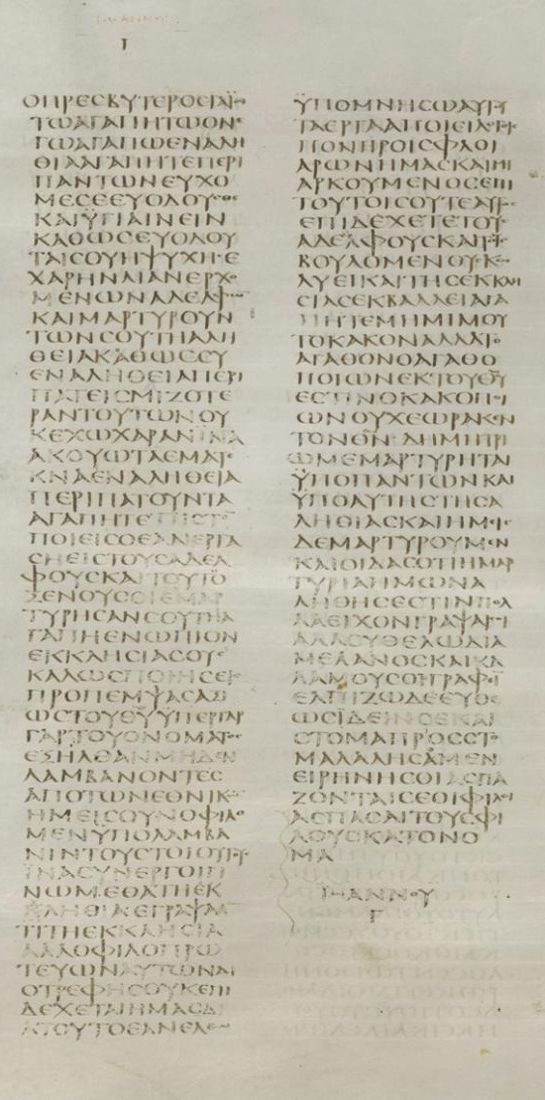
3 John in Codex Sinaiticus
Codex Sinaiticus, copied about AD 330 to 360. These two columns hold all of 3 John, from The elder, to Gaius at the top to the words Ioannou G at the bottom, meaning John's third letter. Kept at the British Library, London. Public domain.
THE OLDEST COPIES. 3 John is the shortest book in the Bible, so it rarely shows up on old scraps. The oldest copies are the two great Bibles of the 300s, Codex Sinaiticus, shown here, and Codex Vaticanus. Codex Alexandrinus follows in the 400s.
HOW IT WAS FOUND. Constantin von Tischendorf found Codex Sinaiticus at St. Catherine's Monastery at the foot of Mount Sinai in 1844 and 1859. In 1933 the British Museum bought most of it from the Soviet government for 100,000 pounds.
SLOW TO BE ACCEPTED. About AD 325 Eusebius listed 2 and 3 John among the books some still questioned, though most churches used them (Church History 3.25). The old Syriac Bible, the Peshitta, about AD 400, left out 2 and 3 John, 2 Peter, Jude and Revelation.
The Setting
2 John told a church not to host false teachers. 3 John is the other side of the coin: host the true ones. Missionaries went from town to town living on the kindness of believers, because they would not take money from pagans, verse 7. Gaius opened his home. But in one church a man named Diotrephes had taken charge. He would not read John's letter to the church, he spread rumors about John, and he threw out anyone who welcomed the traveling brothers. So the old apostle writes a personal note to his friend: you are doing it right, Diotrephes is not, and I am coming.
What Was Going Wrong
A Church Boss. Diotrephes loved to be first and would not accept John's letter, verse 9.
Gossip. He spread wicked talk about John and the others, verse 10.
Closed Doors. He refused to welcome the missionaries and stopped others from doing it, verse 10.
Kicked Out. He put out of the church anyone who helped them, verse 10.
Where to Find Jesus
3 John 1:7. They went out for the sake of the Name, the name of Jesus, Acts 5:41.
3 John 1:11. Whoever does good is of God; whoever does evil has not seen God.
Cool Stuff Most People Miss
Fewest Words. About 219 Greek words, the shortest book in the Bible by word count. 2 John has fewer verses.
No Jesus By Name. The only New Testament book that never says Jesus or Christ. He is called the Name, verse 7.
Church Politics. In verses 9 to 10 a local leader shuts out an apostle. Even John had a church boss problem.
Twin Endings. Verses 13 to 14 almost repeat 2 John 12. See Paper and Ink in 2 John.
A Famous Verse. Verse 2 helped launch the health and wealth movement. See the Big Question pages.
What Happened Next?
We never hear about Gaius, Diotrephes or Demetrius again in the Bible. Like 2 John, this little letter was doubted by some churches for a while, but it was accepted widely and listed by Athanasius in AD 367 among the 27 New Testament books. Nearly 1900 years later its second verse became one of the most quoted verses in the world; see Health and Wealth?
Chapter 1 in 30 seconds
The elder writes to his friend Gaius and prays he is doing as well in body as he is in soul. Gaius has been taking in traveling missionaries, and John says keep it up: helping them makes you part of the work. Then there is Diotrephes, a church boss who loves to be first, trashes John, turns the missionaries away and kicks out anyone who helps them. John says copy what is good, not what is evil, puts in a good word for Demetrius, and saves the rest for a face to face talk.
3JN 1:1[NOTE]GAIUS. A common Roman name. This Gaius is not known from anywhere else for sure. THE ELDER. The same writer as 2 John.
2Beloved, I pray that in every way you may prosper and enjoy good health, as your soul also prospers.3For I was overjoyed when the brothers came and testified about your devotion to the truth, in which you continue to walk. 4I have no greater joy than to hear that my children are walking in the truth.
3JN 1:2[NOTABLE]A loving prayer for a friend. Is it a promise of health and wealth for every believer? See the Big Question pages in 3 John.
3JN 1:2[NOTE]PROSPER. Does this promise health and wealth to every believer? See the Big Question pages, Health and Wealth?
3JN 1:4[NOTABLE]What makes a spiritual father happiest is not size or money but kids who keep walking with God.
Gaius Commended for Hospitality
5Beloved, you are faithful in what you are doing for the brothers, and especially since they are strangers to you. 6They have testified to the church about your love. You will do well to send them on their way in a manner worthy of God. 7For they went out on behalf of the Name, accepting nothing from the Gentiles.8Therefore we ought to support such men, so that we may be fellow workers for the truth.
3JN 1:7[NOTABLE]The people who send and pay for missionaries share in their work.
3JN 1:7[NOTE]THE NAME. The name of Jesus, Acts 5:41. Gentiles here means pagans: the missionaries took no money from unbelievers, so no one could say they were selling the gospel.
Diotrephes and Demetrius
9I have written to the church about this, but Diotrephes, who loves to be first, will not accept our instruction. 10So if I come, I will call attention to his malicious slander against us. And unsatisfied with that, he refuses to welcome the brothers and forbids those who want to do so, even putting them out of the church.
3JN 1:9[NOTE]DIOTREPHES. A church leader who loved to be first. See the Field Notes page Diotrephes.
11Beloved, do not imitate what is evil, but what is good. The one who does good is of God; the one who does evil has not seen God.
3JN 1:11[DEMONIC]Do not imitate what is evil; whoever does evil has not seen God
12Demetrius has received a good testimony from everyone, and from the truth itself. We also testify for him, and you know that our testimony is true.
3JN 1:12[NOTE]DEMETRIUS. Probably the man carrying this letter. John vouches for him, like a letter of recommendation.
Conclusion// 2 John 1:12–13
13I have many things to write to you, but I would prefer not to do so with pen and ink. 14Instead, I hope to see you soon and speak with you face to face.
Peace to you.
The friends here send you greetings.
Greet each of our friends there by name.
See the whole Bible light up in color.
Nate's Highlighting Guide lists every prophecy, fulfillment, miracle and bloodline name in one place, so you can mark your own Bible with the same 15 colors.
TOM is The Owner's Manual, a free translation built on the Berean Standard Bible. It uses modern measurements, prints Yahweh where the Hebrew has God's name, and puts words missing from the earliest manuscripts in [square brackets]. Every change is listed in How It Was Translated.
What do the colors mean?
Each color marks one kind of verse: lime green for prophecies about the Messiah, teal for miracles, sand for archaeology, and so on. Tap any color in the chapter key to turn it off. Use Customize to choose exactly which ones you see.
Can I read without highlights?
Yes. Turn off the Highlights switch at the top for plain text. Your choice is remembered on this device.
Do the other translations have the colors too?
Yes. The colors, red letters, bloodline names and study notes come from TOM and are matched to every other translation verse by verse, so you can read the KJV, NIV or any other translation here with the same study helps.
Is this free?
Yes. The whole Bible is free to read online. The printed Owner's Manual Study Bible is coming soon.