Moses, according to Jewish and Christian tradition. Jesus called it the book of Moses (Mark 12:26). Many modern scholars think it was put together from older sources over time.
EVENTS TOOK PLACE
From slavery in Egypt to the tabernacle at Mount Sinai. The date is debated: about 1446 BC from 1 Kings 6:1, or about 1270 BC in the time of Ramesses II.
DATE WRITTEN
Traditionally about 1440 to 1400 BC, during the forty years in the wilderness. Many scholars say it reached its final form much later, around 500 BC.
WRITTEN TO
The people of Israel, so they would never forget who rescued them.
ANCIENT MANUSCRIPTS
About fifteen copies of Exodus were found among the Dead Sea Scrolls. It was also translated into Greek, in the Septuagint, around 250 BC.
KEY VERSE
Exodus 20:2. I am Yahweh your God, who brought you out of the land of Egypt, out of the house of slavery.
One of the Oldest Pieces of Exodus
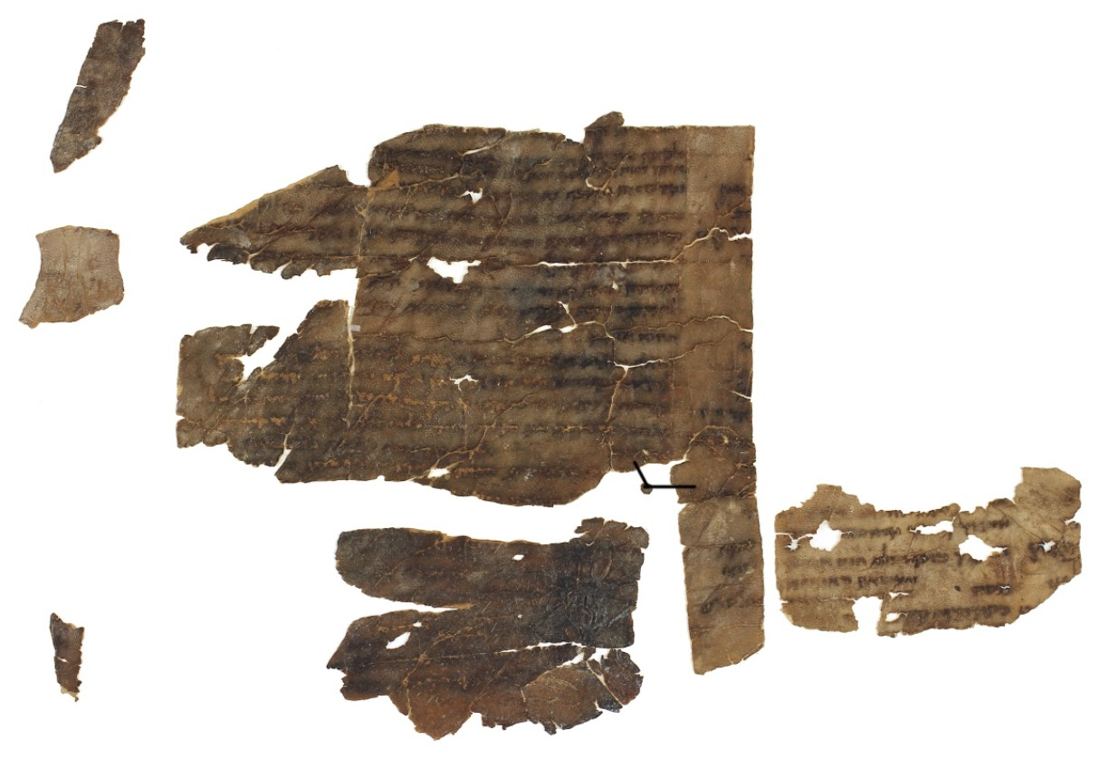
This scroll is called 4QExod Lev f, which means a copy of Exodus and Leviticus from Cave 4 at Qumran. It was found with the Dead Sea Scrolls, and the photo shows all of its surviving pieces. They hold parts of the last chapters of Exodus and the first chapter of Leviticus, all on one scroll. Experts date it by its handwriting to about 250 BC, which makes it one of the oldest Bible scrolls ever found. That is about 250 years before Jesus was born. It is kept in Jerusalem.
The Setting
Egypt was the richest and strongest nation on earth. Its Pharaohs were worshiped as gods, and so were the Nile, the sun, frogs and cows. Jacob's family had moved there in a famine, and they settled in Goshen, the green land of the Nile Delta. Over time they grew into a huge nation, and a new Pharaoh made them slaves. Which Pharaoh is not named. The early date points to Thutmose III or Amenhotep II, the late date to Ramesses II, one of Egypt's most famous builders.
What Was Going Wrong
Slavery And Murder. Pharaoh worked Israel without mercy and ordered every Hebrew baby boy thrown into the Nile (1:13 to 14, 1:22).
The Gods of Egypt. Egypt worshiped many gods, and God said He would bring judgment on all of them (12:12).
A Hard Heart. Pharaoh hardened his heart again and again, even when he could see what God was doing (8:15, 8:32, 9:34).
A Leader Full of Excuses. Moses told God five different ways that he was the wrong man for the job (3:11, 3:13, 4:1, 4:10, 4:13).
Grumbling. Days after the sea parted, the people were complaining about water, food and Moses (15:24, 16:2 to 3, 17:3).
The Golden Calf. Forty days after they promised to obey, they made an idol and threw a party for it (24:7, 32:1 to 6).
Where to Find Jesus
Exodus 3:14. God's name I AM. Jesus said, Before Abraham was born, I am, in John 8:58.
Exodus 12:5 to 13. The spotless Passover lamb. Christ is our Passover lamb, 1 Corinthians 5:7.
Exodus 12:46. Not one bone of the lamb was to be broken, fulfilled at the cross, John 19:36.
Exodus 16:4. Bread from heaven. Jesus is the true bread from heaven, John 6:32 to 35.
Exodus 17:6. Water from the rock. Paul says that rock was Christ in 1 Corinthians 10:4.
Exodus 25:8. God's tent among His people. The Word pitched His tent among us, John 1:14.
Cool Stuff Most People Miss
The Ten Commandments Show Up Twice. They are in Exodus 20 and Deuteronomy 5, with small differences, mostly in the Sabbath command. Before the Dead Sea Scrolls, the oldest Hebrew Bible text known was the Nash Papyrus, with the Ten Commandments on it.
Why Moses Has Horns. Exodus 34:29 says Moses' face was shining. The Hebrew word for shine is close to horn, and the old Latin Bible said horned. So Michelangelo's Moses has two little horns.
What Is It. Manna comes from man hu, Hebrew for What is it? Israel ate a question for forty years.
The First Spirit Filled Artist. Bezalel is filled with God's Spirit to do art, 31:2 to 5. God cares about beauty.
The Blueprints Take Up A Third. Thirteen of forty chapters are about the tabernacle, where God would meet His people.
The Firstborn Are Bought Back. Every firstborn belongs to God, but Israel buys back each firstborn son instead of sacrificing him (13:13, 34:20). The nations burned children, which God hated (Leviticus 18:21).
Did Anybody Listen?
Sometimes. Forty days after promising to obey, they made a golden calf. But Moses prayed, God forgave them, and Exodus ends with God's glory filling the tent.
Chapter 1 in 30 seconds
Jacob's family grows from seventy people into a nation, and a new Pharaoh who never knew Joseph gets nervous. He turns them into slaves and makes them build store cities. When that does not slow them down, he orders the Hebrew midwives to kill the baby boys. The midwives fear God more than Pharaoh and quietly refuse.
The Israelites Multiply in Egypt// Genesis 46:7–27
1These are the names of the sons of Israel who went to Egypt with Jacob, each with his family:
2Reuben, Simeon, Levi, and Judah;
3Issachar, Zebulun, and Benjamin;
4Dan and Naphtali;
Gad and Asher.
5The descendants of Jacob numbered seventy in all, including Joseph, who was already in Egypt.
6Now Joseph and all his brothers and all that generation died, 7but the Israelites were fruitful and increased rapidly; they multiplied and became exceedingly numerous, so that the land was filled with them.
EX 1:7[FULFILLS]God promised Abraham a land, descendants, and that he would father a great nation ← GEN 12:1-3
EX 1:7[FULFILLS]God told Jacob he would become a great nation in Egypt, be brought back, and Joseph would close his eyes ← GEN 46:3-4
Oppression by a New King// Acts 7:15–19
8Then a new king, who did not know Joseph, came to power in Egypt.9“Look,” he said to his people, “the Israelites have become too numerous and too powerful for us. 10Come, let us deal shrewdly with them, or they will increase even more; and if a war breaks out, they may join our enemies, fight against us, and leave the country.”
EX 1:8[QUOTED]Quoted in the New Testament → ACTS 7:18
11So the Egyptians appointed taskmasters over the Israelites to oppress them with forced labor. As a result, they built Pithom and Rameses as store cities for Pharaoh.12But the more they were oppressed, the more they multiplied and flourished; so the Egyptians came to dread the Israelites.
EX 1:11[ARCHAEOLOGY]The store cities named in Exodus are real Egyptian sites
EX 1:11[NOTE]WHEN? See When Was the Exodus?
13They worked the Israelites ruthlessly 14and made their lives bitter with hard labor in brick and mortar, and with all kinds of work in the fields. Every service they imposed was harsh.
15Then the king of Egypt said to the Hebrew midwives, whose names were Shiphrah and Puah, 16“When you help the Hebrew women give birth, observe them on the birthstools. If the child is a son, kill him; but if it is a daughter, let her live.”
EX 1:15[FIELD NOTES]An Egyptian list of household servants from about 1740 BC includes a woman named Shiphrah. See the Brooklyn Papyrus Field Notes page.
17The midwives, however, feared God and did not do as the king of Egypt had instructed; they let the boys live. 18So the king of Egypt summoned the midwives and asked them, “Why have you done this? Why have you let the boys live?”
19The midwives answered Pharaoh, “The Hebrew women are not like the Egyptian women, for they are vigorous and give birth before a midwife arrives.”
20So God was good to the midwives, and the people multiplied and became even more numerous. 21And because the midwives feared God, He gave them families of their own.
22Then Pharaoh commanded all his people: “Every son born to the Hebrews you must throw into the Nile, but every daughter you may allow to live.”
See the whole Bible light up in color.
Nate's Highlighting Guide lists every prophecy, fulfillment, miracle and bloodline name in one place, so you can mark your own Bible with the same 15 colors.
TOM is The Owner's Manual, a free translation built on the Berean Standard Bible. It uses modern measurements, prints Yahweh where the Hebrew has God's name, and puts words missing from the earliest manuscripts in [square brackets]. Every change is listed in How It Was Translated.
What do the colors mean?
Each color marks one kind of verse: lime green for prophecies about the Messiah, teal for miracles, sand for archaeology, and so on. Tap any color in the chapter key to turn it off. Use Customize to choose exactly which ones you see.
Can I read without highlights?
Yes. Turn off the Highlights switch at the top for plain text. Your choice is remembered on this device.
Do the other translations have the colors too?
Yes. The colors, red letters, bloodline names and study notes come from TOM and are matched to every other translation verse by verse, so you can read the KJV, NIV or any other translation here with the same study helps.
Is this free?
Yes. The whole Bible is free to read online. The printed Owner's Manual Study Bible is coming soon.