Paul, with Timothy, verse 1. Almost all scholars agree Paul wrote it.
WRITTEN FROM
Prison, verse 9, most likely in Rome. Many scholars say Ephesus, only about 100 miles from Colossae; a few say Caesarea.
DATE WRITTEN
About AD 60 to 62, at the same time as Colossians.
WRITTEN TO
Philemon, a believer in Colossae, and the church that met in his house, verse 2.
WHY HE WROTE
To ask Philemon to welcome back Onesimus, his runaway slave, as a brother in Christ.
KEY VERSE
Philemon 16. No longer as a slave, but better than a slave, as a beloved brother.
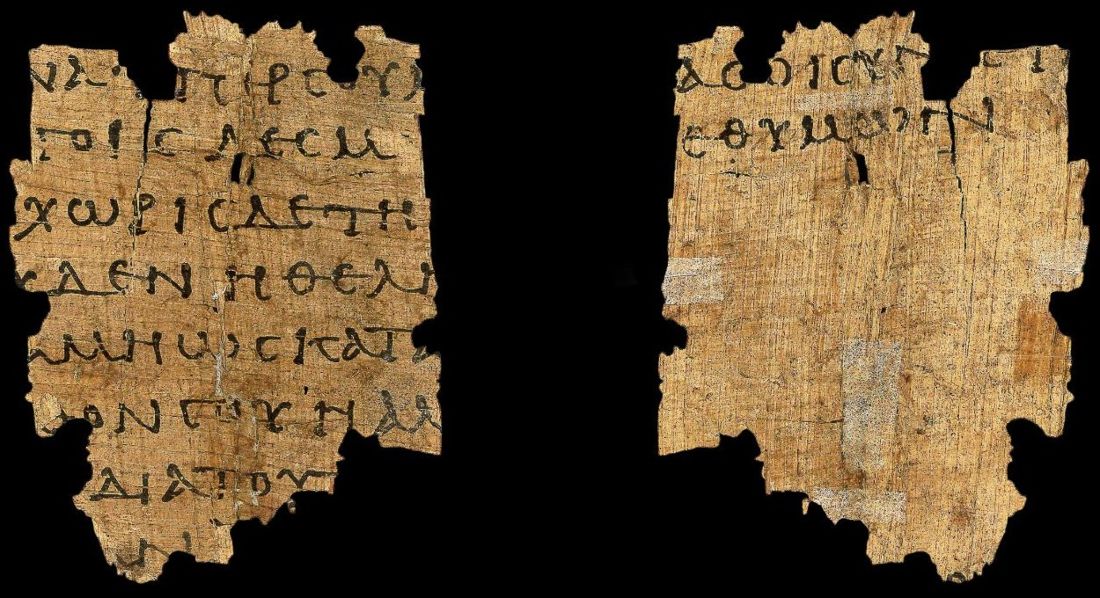
An Early Copy of Philemon
Papyrus 87, front and back, copied in the early 200s. One side has verses 13 to 15, the other verses 24 to 25. It is kept at the University of Cologne in Germany. Public domain.
The Setting
Philemon was a believer in Colossae who had a church meeting in his house. One of his slaves, Onesimus, ran away, and may have taken money too, verse 18. Somehow he ended up with Paul, who was in prison, and there he became a Christian. Now Paul has a problem. Under Roman law Onesimus belonged to Philemon. So Paul sends him back, carried along with the letter to the Colossians by Tychicus, Colossians 4:7 to 9, and writes this short note to change how Philemon sees him. It is the shortest of Paul's letters, and the most personal.
What Was At Stake
A Runaway. Onesimus had left his master, verses 15 to 16.
A Debt. He may have owed Philemon money, verse 18.
The Law. Roman law gave a master full power over a slave who ran away.
A New Brother. Now master and slave were both believers. How should they treat each other?
Where to Find Jesus
Philemon 6. Every good thing that is ours in Christ.
Philemon 16. In the Lord, a slave and a master become brothers. Galatians 3:28.
Philemon 18 to 19. Paul pays the debt of the guilty one, a picture of what Christ does for us. Colossians 2:14.
Cool Stuff Most People Miss
A Pun in the Bible. Onesimus means useful. Paul says he was useless, but now he is useful, verse 11.
Signed By Hand. Paul signs it himself, like an IOU, verse 19.
One of the Oldest. Papyrus 87, from the early 200s, is one of the oldest scraps of Paul's letters.
Luther'S Words. Martin Luther, 1522: we are all His Onesimus, if we believe.
What Happened Next?
We do not know Philemon's answer, but the letter was kept, which suggests he said yes. Colossians 4:9 calls Onesimus a faithful and beloved brother. About AD 110, Ignatius praised a bishop of Ephesus named Onesimus. It may be the same man.
Chapter 1 in 30 seconds
Paul writes from prison to his friend Philemon about a runaway slave named Onesimus. The runaway met Paul, met Jesus, and became a new man. Now Paul sends him home with a note: take him back, not as a slave but as a brother. If he owes you anything, put it on my tab. Oh, and get the guest room ready.
Greetings from Paul and Timothy// Philippians 1:1–2; Colossians 1:1–2
1Paul, a prisoner of Christ Jesus, and Timothy our brother,
To Philemon our beloved fellow worker, 2to Apphia our sister, to Archippus our fellow soldier, and to the church that meets at your house:
PHM 1:2[NOTE]THE HOUSE CHURCH. There were no church buildings yet, so believers met in homes. Many think Apphia was Philemon's wife and Archippus their son. Paul tells Archippus to finish his work for the Lord, Colossians 4:17.
3Grace and peace to you from God our Father and the Lord Jesus Christ.
Philemon’s Faith and Love
4I always thank my God, remembering you in my prayers, 5because I hear about your faith in the Lord Jesus and your love for all the saints. 6I pray that your partnership in the faith may become effective as you fully acknowledge every good thing that is ours in Christ. 7I take great joy and encouragement in your love, because you, brother, have refreshed the hearts of the saints.
PHM 1:7[NOTABLE]Philemon was known for one thing: people left his house encouraged. Paul asks him to do it one more time, verse 20.
Paul’s Appeal for Onesimus
8So although in Christ I am bold enough to order you to do what is proper,9I prefer to appeal on the basis of love. For I, Paul, am now aged, and a prisoner of Christ Jesus as well.
PHM 1:8[NOTABLE]Paul had the authority to give an order. He asked out of love instead. Real leaders win hearts, not just obedience.
10I appeal to you for my child Onesimus, whose father I became while I was in chains.11Formerly he was useless to you, but now he has become useful both to you and to me.12I am sending back to you him who is my very heart.
PHM 1:10[ARCHAEOLOGY]Marble plaque honoring Pliny the Younger, the Roman who wrote a famous letter asking mercy for a freedman
PHM 1:10[NOTABLE]Onesimus means useful. The man who once lived up to his name the wrong way was changed by Jesus. No one is too useless for God.
PHM 1:11[NOTE]USELESS TO USEFUL. Onesimus means useful. Paul plays on the name: once useless, now useful. Some hear a second pun, because the Greek word for useful sounded almost like Christ.
PHM 1:12[ARCHAEOLOGY]A Roman iron slave collar with a bronze tag offering a gold coin for returning a runaway to his master Zoninus
PHM 1:12[NOTE]SENT BACK. Most believe Onesimus was a runaway, as John Chrysostom said about AD 400. Some think he went to Paul on purpose to ask him to make peace with his master; others that Philemon sent him to help Paul; a few that he was Philemon's brother, not a slave. Deuteronomy 23:15 to 16 says not to hand back a runaway. Some answer that the law was for slaves fleeing to Israel from other nations; others that Paul would not act without Philemon's consent, verse 14, and sent him as a brother, not as property.
13I would have liked to keep him with me, so that on your behalf he could minister to me in my chains for the gospel. 14But I did not want to do anything without your consent, so that your goodness will not be out of compulsion, but by your own free will. 15For perhaps this is why he was separated from you for a while, so that you might have him back for good—16no longer as a slave, but better than a slave, as a beloved brother. He is especially beloved to me, but even more so to you, both in person and in the Lord.
PHM 1:15[NOTABLE]The gospel turned a runaway and his master into family. In Christ the walls between people come down, Galatians 3:28.
PHM 1:16[NOTE]SLAVE AND BROTHER. See The Big Question pages, The Bible and Slavery, and the Titus 2:9 note.
17So if you consider me a partner, receive him as you would receive me.18But if he has wronged you in any way or owes you anything, charge it to my account.19I, Paul, write this with my own hand. I will repay it—not to mention that you owe me your very self.
PHM 1:17[NOTABLE]Paul takes the slave's debt on himself. Martin Luther wrote in 1522 that Christ does the same for us before the Father: we are all His Onesimus.
PHM 1:19[ARCHAEOLOGY]A loan contract on papyrus from the Jewish colony at Elephantine, Egypt, about 402 BC, with repayment terms, guarantors and witnesses
PHM 1:19[NOTE]MY OWN HAND. Paul usually spoke his letters to a helper and signed the end himself, Galatians 6:11 and 2 Thessalonians 3:17. Here his signature works like an IOU.
20Yes, brother, let me have some benefit from you in the Lord. Refresh my heart in Christ.
21Confident of your obedience, I write to you, knowing that you will do even more than I ask.
22In the meantime, prepare a guest room for me, because I hope that through your prayers I will be restored to you.
PHM 1:22[NOTE]A GUEST ROOM. Paul expected to be set free, Philippians 1:25. Clement of Rome, about AD 96, says Paul reached the limit of the west, and many believe he was released and traveled again before his second arrest. See 2 Timothy.
Additional Greetings
23Epaphras, my fellow prisoner in Christ Jesus, sends you greetings, 24as do Mark, Aristarchus, Demas, and Luke, my fellow workers.
PHM 1:24[NOTE]THE SAME TEAM. These are the same friends who send greetings in Colossians 4:10 to 14. Mark is the young man Paul once refused to take along, Acts 15:37 to 39. Luke is the doctor who wrote Luke and Acts. Demas later left Paul, 2 Timothy 4:10.
25The grace of the Lord Jesus Christ be with your spirit.
PHM 1:25[NOTE]WHAT HAPPENED TO ONESIMUS? About AD 110, Ignatius praised a bishop of Ephesus named Onesimus. Some think it was the same man, and that he later helped gather Paul's letters, which would explain why this tiny note was saved. It is possible, but no one knows.
See the whole Bible light up in color.
Nate's Highlighting Guide lists every prophecy, fulfillment, miracle and bloodline name in one place, so you can mark your own Bible with the same 15 colors.
TOM is The Owner's Manual, a free translation built on the Berean Standard Bible. It uses modern measurements, prints Yahweh where the Hebrew has God's name, and puts words missing from the earliest manuscripts in [square brackets]. Every change is listed in How It Was Translated.
What do the colors mean?
Each color marks one kind of verse: lime green for prophecies about the Messiah, teal for miracles, sand for archaeology, and so on. Tap any color in the chapter key to turn it off. Use Customize to choose exactly which ones you see.
Can I read without highlights?
Yes. Turn off the Highlights switch at the top for plain text. Your choice is remembered on this device.
Do the other translations have the colors too?
Yes. The colors, red letters, bloodline names and study notes come from TOM and are matched to every other translation verse by verse, so you can read the KJV, NIV or any other translation here with the same study helps.
Is this free?
Yes. The whole Bible is free to read online. The printed Owner's Manual Study Bible is coming soon.