Paul, 1:1. Most critical scholars think a follower wrote the three Pastoral Letters about AD 90 to 130. See the 1 Timothy facts.
WRITTEN FROM
Probably Macedonia or Greece, on the way to Nicopolis, 3:12.
DATE WRITTEN
About AD 62 to 65, between Paul's two Roman arrests.
WRITTEN TO
Titus, a Greek believer Paul left on the island of Crete, 1:5.
WHY HE WROTE
To help Titus finish setting up the churches, choose good leaders, and stop false teachers.
KEY VERSE
Titus 3:5. He saved us, not by the righteous deeds we had done, but according to His mercy.
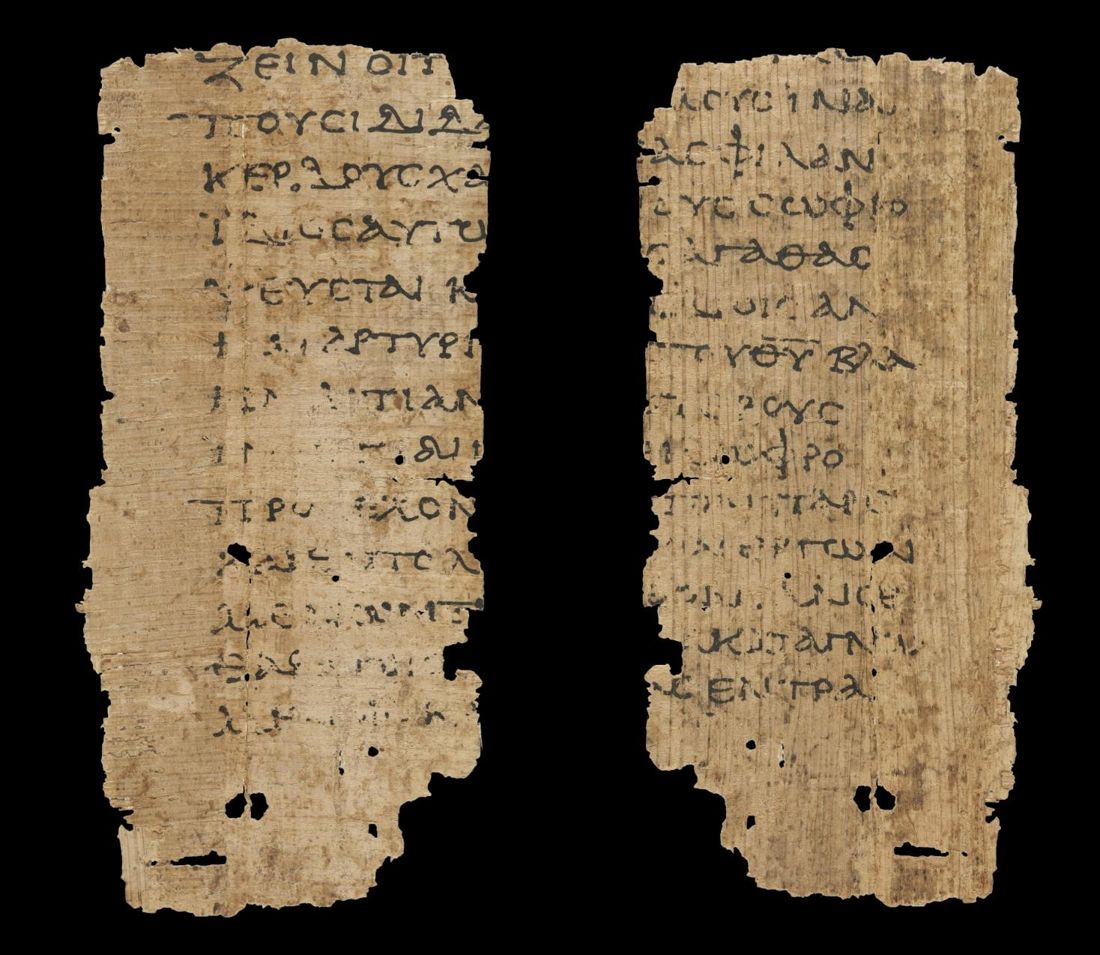
An Early Copy of Titus
Papyrus 32, front and back, copied about AD 200. One side has Titus 1:11 to 15, right where Paul quotes the Cretan poet. The other side has 2:3 to 8. It is about 4 inches tall and is kept in the John Rylands Library in Manchester, England. Public domain.
The Setting
Acts never mentions Titus by name, but Paul's letters do. He was a Greek who was never circumcised, Galatians 2:3, and Paul sent him to fix problems in Corinth, 2 Corinthians 7 and 8. Most think that after Paul's first arrest in Rome, the two of them went to Crete, a big island south of Greece. Paul moved on and left Titus to finish the work. Crete had a bad name. Even Greeks used Cretan as a word for liar. Into that place Paul sends a short letter about good leaders, good lives and God's kindness.
What Was Going Wrong
No Leaders. The new churches had no elders yet, 1:5.
False Teachers. Talkers who taught for money and upset whole families, 1:10 to 11.
Myths And Fights. Jewish myths, family lines and arguments about the law, 1:14 and 3:9.
Bad Name. Cretans were known as liars, 1:12, so their lives had to back up the gospel, 2:5 to 10.
Where to Find Jesus
Titus 2:13. Our great God and Savior Jesus Christ. One of the clearest verses calling Jesus God. Isaiah 9:6.
Titus 2:14. He gave Himself for us to redeem us and make us His own people.
Titus 3:4 to 6. God's kindness appeared, and through Jesus He poured out the Spirit. Joel 2:28.
Cool Stuff Most People Miss
A Poet in the Bible. Paul quotes a Cretan poet from about 600 BC, 1:12.
One of the Oldest Scraps. Papyrus 32, about AD 200, is one of the oldest pieces of the New Testament.
Same Leaders, Two Names. Paul calls the same leaders elders in 1:5 and overseers in 1:7.
Luther'S Favorite. Martin Luther's Small Catechism, 1529, quotes Titus 3:5 to 8 to explain baptism.
What Happened Next?
Titus later went to Dalmatia, on the coast north of Greece, 2 Timothy 4:10. Church historian Eusebius, about AD 325, says Titus led the churches of Crete, and tradition says he lived there to an old age. A large church was built for him at Gortyn in the 500s, and its ruins still stand.
Chapter 1 in 30 seconds
Paul left Titus on Crete with a to do list: finish the job and pick good leaders in every town. Not bullies, not drunks, not money grabbers. Why so picky? Because some teachers there are talking big and teaching junk for cash. Even a Cretan poet said Cretans are liars.
1Paul, a servant of God and an apostle of Jesus Christ for the faith of God’s elect and their knowledge of the truth that leads to godliness, 2in the hope of eternal life, which God, who cannot lie, promised before time began. 3In His own time He has made His word evident in the proclamation entrusted to me by the command of God our Savior.
4To Titus, my true child in our common faith:
Grace and peace from God the Father and Christ Jesus our Savior.
Appointing Elders on Crete// 1 Timothy 3:1–7; 1 Peter 5:1–4
5The reason I left you in Crete was that you would set in order what was unfinished and appoint elders in every town, as I directed you.6An elder must be blameless, the husband of but one wife, having children who are believers and who are not open to accusation of indiscretion or insubordination.
TIT 1:5[ARCHAEOLOGY]Knossos, the great palace city of Bronze Age Crete, with clay tablets in Linear B, the oldest written Greek
TIT 1:6[NOTE]ELDERS AND OVERSEERS. Paul calls the same leaders elders in 1:5 and overseers in 1:7. Jerome noticed this in the late 300s. For husband of but one wife, see the 1 Timothy 3:2 note.
7As God’s steward, an overseer must be above reproach—not self-willed, not quick-tempered, not given to drunkenness, not violent, not greedy for money. 8Instead, he must be hospitable, a lover of good, self-controlled, upright, holy, and disciplined. 9He must hold firmly to the faithful word as it was taught, so that he can encourage others by sound teaching and refute those who contradict it.
Correcting False Teachers// 1 Timothy 1:3–11
10For many are rebellious and full of empty talk and deception, especially those of the circumcision, 11who must be silenced. For the sake of dishonorable gain, they undermine entire households and teach things they should not. 12As one of their own prophets has said, “Cretans are always liars, evil beasts, lazy gluttons.”
TIT 1:12[ARCHAEOLOGY]Bronze shields from the cave on Mount Ida where Cretans said Zeus was raised
TIT 1:12[NOTABLE]Paul quotes Epimenides, a poet from Crete, from about 600 BC. Paul even calls him one of their own prophets.
TIT 1:12[NOTE]THE CRETAN LIAR. The poet is Epimenides of Knossos, about 600 BC, as Clement of Alexandria said about AD 200. Acts 17:28 may quote the same poem, but that is debated. Teachers of logic later made the line a puzzle: if a Cretan says all Cretans lie, is he lying? That puzzle dates only from the 1800s. Paul is not playing games: he says this testimony is true, 1:13. See The Cave of Zeus Field Notes page.
13This testimony is true. Therefore rebuke them sternly, so that they will be sound in the faith 14and will pay no attention to Jewish myths or to the commands of men who have rejected the truth.
TIT 1:14[NOTE]JEWISH MYTHS. Probably made up stories built on Old Testament names and family lines, plus rules about clean and unclean food, 1:15. Writings of the time like the Book of Jubilees retold Genesis with many extra details. See 1 Timothy 1:4 and 3:9.
15To the pure, all things are pure; but to the defiled and unbelieving, nothing is pure. Indeed, both their minds and their consciences are defiled. 16They profess to know God, but by their actions they deny Him. They are detestable, disobedient, and unfit for any good deed.
TIT 1:16[NOTABLE]Saying you know God and living like you do not are two different things. Your life is the loudest sermon you preach.
See the whole Bible light up in color.
Nate's Highlighting Guide lists every prophecy, fulfillment, miracle and bloodline name in one place, so you can mark your own Bible with the same 15 colors.
TOM is The Owner's Manual, a free translation built on the Berean Standard Bible. It uses modern measurements, prints Yahweh where the Hebrew has God's name, and puts words missing from the earliest manuscripts in [square brackets]. Every change is listed in How It Was Translated.
What do the colors mean?
Each color marks one kind of verse: lime green for prophecies about the Messiah, teal for miracles, sand for archaeology, and so on. Tap any color in the chapter key to turn it off. Use Customize to choose exactly which ones you see.
Can I read without highlights?
Yes. Turn off the Highlights switch at the top for plain text. Your choice is remembered on this device.
Do the other translations have the colors too?
Yes. The colors, red letters, bloodline names and study notes come from TOM and are matched to every other translation verse by verse, so you can read the KJV, NIV or any other translation here with the same study helps.
Is this free?
Yes. The whole Bible is free to read online. The printed Owner's Manual Study Bible is coming soon.