
TOM · The Owner's Manual · Old Testament

Judges 1

Before you read Judges: who, when, why

BOOK 7 OF 66 · OLD TESTAMENT · HISTORY

12 Tribes, 12 Districts, No King

AUTHOR
The book does not name its author. Jewish tradition in the Talmud says Samuel wrote it. The line In those days there was no king in Israel shows it was written after Israel had kings, and 18:30 mentions the captivity of the land, so someone also finished it later. Many scholars think it was put together in the 600s or 500s BC.
EVENTS TOOK PLACE
From Joshua's death until just before Samuel. Jephthah says Israel had been in the land three hundred years, 11:26. Adding up every number in the book gives about 410 years, but some judges lived at the same time in different parts of the land.
DATE
The early date puts the judges from about 1380 to 1050 BC. The late date puts them from about 1200 to 1050 BC. See When Was the Conquest? in Joshua.
WRITTEN TO
Israel, to show what happens when everyone does what is right in his own eyes, and why the nation needed a king who followed God.
KEY VERSE
Judges 21:25. In those days there was no king in Israel; everyone did what was right in his own eyes.
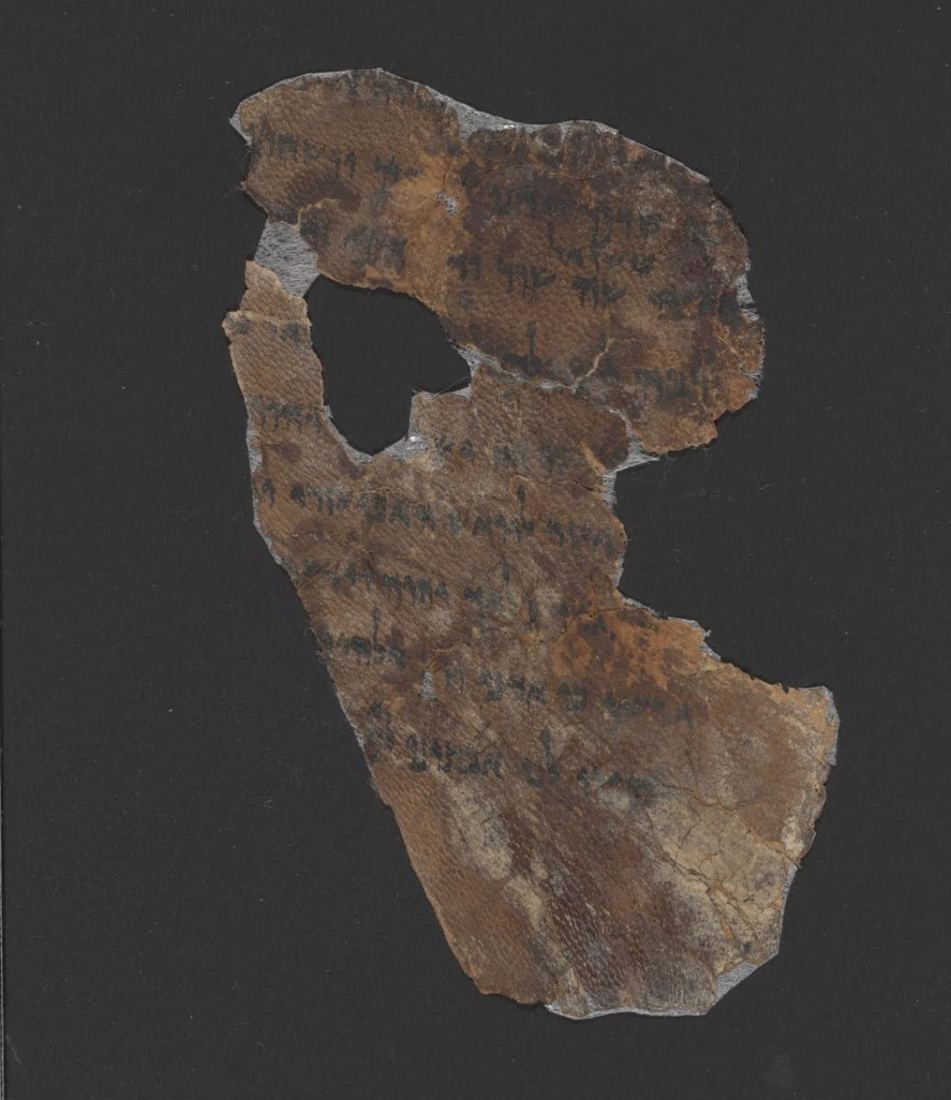
THE OLDEST COPY OF JUDGES

The Oldest Copy of Judges

These two pieces of leather come from 4QJudg a, a scroll of Judges found in Cave 4 at Qumran, near the Dead Sea. It was copied about 50 to 25 BC, around the time Herod the Great became king. It is the oldest copy of Judges known. It holds parts of Judges 6, the call of Gideon. One thing stands out. It goes straight from 6:6 to 6:11 and does not have the prophet's speech in 6:7 to 10. Scholars still argue whether those verses were added to later copies or left out of this one. See the TEXT note at 6:7. Pieces of two more Judges scrolls were found at Qumran. The Greek Bible has two different forms of Judges, one in Codex Alexandrinus and one in Codex Vaticanus. Photo Shai Halevi, Israel Antiquities Authority, Leon Levy Dead Sea Scrolls Digital Library.

The Setting

Joshua already split the Promised Land into tribal districts, Joshua 13 to 21. Now Joshua is dead, and no one is in charge. Think of 12 counties in one state, but no governor, no capital and no army. Each tribe runs its own district, and they do not always get along. The Canaanites still live among them, and so do their gods. When trouble comes, God raises up a judge, a local hero, to the rescue.

What Was Going Wrong

  • Half Finished. Tribe after tribe did not drive out the Canaanites (1:19 to 35).
  • Idols Everywhere. Israel served the Baals and the Ashtoreths again and again (2:11 to 13, 10:6). Even Gideon made a gold ephod that became an idol (8:27).
  • Child Sacrifice. Jephthah vowed to offer whatever came out his door, and his only daughter came out. Most ancient readers, and most scholars today, say he really sacrificed her; others say she served God for life and never married. God never asked for it and hated child sacrifice (Deuteronomy 12:31). Hebrews 11:32 praises Jephthah's faith, not his vow (11:30 to 40).
  • Brother Against Brother. Abimelech killed seventy brothers (9:5), Gilead fought Ephraim (12:1 to 6), and all Israel fought Benjamin (20:1 to 48).
  • No King. Everyone did what was right in his own eyes (17:6, 21:25). The book ends with stolen idols, a murdered woman and a civil war (17 to 21).

Where to Find Jesus

  • Judges 2:16. Yahweh raised up judges, who saved them. Every judge was a small savior who died. Jesus is the Savior and Judge who never dies, Acts 17:31.
  • Judges 13:3 to 5. An angel tells a woman she will have a son who will begin to save Israel. Centuries later an angel tells Joseph that Mary will have a Son who will save His people from their sins, Matthew 1:21.
  • Judges 16:30. Samson won his greatest victory in his death, with his arms stretched out between two pillars. Many see a picture of the cross.
  • Judges 21:25. There was no king in Israel. The whole book points ahead to a King, first David, and then the Son of David, Jesus.

Cool Stuff Most People Miss

  • The Left Handed Assassin. Ehud hid a sword on his right thigh, where nobody checked, 3:16 to 22.
  • Shibboleth. A password from 12:6 that is still an English word.
  • Putting Out A Fleece. Gideon's wool fleece became a saying for asking God for a sign, 6:36 to 40.
  • A Very Old Song. The Song of Deborah in chapter 5 may be one of the oldest poems in the Bible.

Did It Get Better?

No. It got worse, all the way to a civil war. But God never gave up on them. Ruth, a love story from the days of the judges, ends with the name David, and Samuel, the last judge, anoints Israel's first kings.

Chapter 1 in 30 seconds

Joshua is dead, and the tribes go out to finish the job. Judah does well. Then the list turns into a report card full of the same comment: did not drive them out. Benjamin, Manasseh, Ephraim, Zebulun, Asher, Naphtali, Dan. The Canaanites are not going anywhere.

Tap a color to hide it

The Conquest of Canaan Proceeds// Joshua 13:1–7

1After the death of Joshua, the Israelites inquired of Yahweh, “Who will be the first to go up and fight for us against the Canaanites?”

  • JUDG 1:1[ARCHAEOLOGY]The first mention of Israel outside the Bible, as a people in Canaan
  • JUDG 1:1[FULFILLS]Moses prayed that God would help Judah against his foes ← DT 33:7MEDIUM
  • JUDG 1:1[NOTE]JUDGES. The Hebrew word shophet means more than a judge in a courtroom. These were leaders God raised up to rescue Israel: Yahweh raised up judges, who saved them, 2:16.
  • JUDG 1:1[NOTE]To see where each tribe lived, look at the map The Land of the Twelve Tribes in Joshua.

2“Judah shall go up,” answered Yahweh. “Indeed, I have delivered the land into their hands.”

3Then the men of Judah said to their brothers the Simeonites, “Come up with us to our allotted territory, and let us fight against the Canaanites. And we likewise will go with you to your territory.” So the Simeonites went with them.

4When Judah attacked, Yahweh delivered the Canaanites and Perizzites into their hands, and they struck down ten thousand men at Bezek. 5And there they found Adoni-bezek and fought against him, striking down the Canaanites and Perizzites. 6As Adoni-bezek

fled, they pursued him, seized him, and cut off his thumbs and big toes. 7Then Adoni-bezek said, “Seventy kings with their thumbs and big toes cut off have gathered the scraps under my table. As I have done to them, so God has repaid me.” And they brought him to Jerusalem, where he died.

  • JUDG 1:7[NOTE]Cutting off thumbs and big toes meant a man could never hold a sword or run into battle again. Adoni Bezek admits he got what he gave.

The Capture of Jerusalem and Hebron// Joshua 15:13–19

8Then the men of Judah fought against Jerusalem and captured it. They put the city to the sword and set it on fire. 9Afterward, the men of Judah marched down to fight against the Canaanites living in the hill country, in the Negev, and in the foothills.

10Judah also marched against the Canaanites who were living in Hebron (formerly known as Kiriath-arba), and they struck down Sheshai, Ahiman, and Talmai.

11From there they marched against the inhabitants of Debir (formerly known as Kiriath-sepher). 12And Caleb said, “To the man who strikes down Kiriath-sepher and captures it, I will give my daughter Acsah in marriage.” 13So Othniel son of Caleb’s younger brother Kenaz captured the city, and Caleb gave his daughter Acsah to him in marriage.

14One day Acsah came to Othniel and urged him to ask her father for a field. When she got off her donkey, Caleb asked her, “What do you desire?”

15“Give me a blessing,” she answered. “Since you have given me land in the Negev, give me springs of water as well.”

So Caleb gave her both the upper and lower springs.

16Now the descendants of Moses’ father-in-law, the Kenite, went up with the men of Judah from the City of Palms to the Wilderness of Judah in the Negev near Arad. They went to live among the people.

17Then the men of Judah went with their brothers the Simeonites, attacked the Canaanites living in Zephath, and devoted the city to destruction. So it was called Hormah. 18And Judah also captured Gaza, Ashkelon, and Ekron—each with its territory. 19Yahweh was with Judah, and they took possession of the hill country; but they could not drive out the inhabitants of the plains because they had chariots of iron.

20Just as Moses had promised, Judah gave Hebron to Caleb, who drove out the descendants of the three sons of Anak.

  • JUDG 1:20[DEMONIC]Caleb drives out the three sons of Anak

21The Benjamites, however, failed to drive out the Jebusites living in Jerusalem. So to this day the Jebusites live there among the Benjamites.

  • JUDG 1:21[NOTE]Judah burned Jerusalem in 1:8 but did not keep it. The Jebusites held the city until King David took it, 2 Samuel 5:6 to 7.

22The house of Joseph also attacked Bethel, and Yahweh was with them. 23They sent spies to Bethel (formerly known as Luz), 24and when the spies saw a man coming out of the city, they said to him, “Please show us how to get into the city, and we will treat you kindly.”

25So the man showed them the entrance to the city, and they put the city to the sword but released that man and all his family. 26And the man went to the land of the Hittites, built a city, and called it Luz, which is its name to this day.

The Failure to Complete the Conquest

27At that time Manasseh failed to drive out the inhabitants of Beth-shean, Taanach, Dor, Ibleam, Megiddo, and their villages; for the Canaanites were determined to dwell in that land. 28When Israel became stronger, they pressed the Canaanites into forced labor, but they never drove them out completely.

  • JUDG 1:28[FULFILLS]Noah said Canaan would become a servant to his brothers ← GEN 9:25MEDIUM

29Ephraim also failed to drive out the Canaanites living in Gezer; so the Canaanites continued to dwell among them in Gezer.

30Zebulun failed to drive out the inhabitants of Kitron and Nahalol; so the Canaanites lived among them and served as forced laborers.

31Asher failed to drive out the inhabitants of Acco, Sidon, Ahlab, Achzib, Helbah, Aphik, and Rehob. 32So the Asherites lived among the Canaanite inhabitants of the land, because they did not drive them out.

33Naphtali failed to drive out the inhabitants of Beth-shemesh and Beth-anath. So the Naphtalites also lived among the Canaanite inhabitants of the land, but the inhabitants of Beth-shemesh and Beth-anath served them as forced laborers.

34The Amorites forced the Danites into the hill country and did not allow them to come down into the plain. 35And the Amorites were determined to dwell in Mount Heres, Aijalon, and Shaalbim. But when the house of Joseph grew in strength, they pressed the Amorites into forced labor. 36And the border of the Amorites extended from the Ascent of Akrabbim to Sela and beyond.

See the whole Bible light up in color.

Nate's Highlighting Guide lists every prophecy, fulfillment, miracle and bloodline name in one place, so you can mark your own Bible with the same 15 colors.

Get the Free Highlighting Guide Free. No spam. Unsubscribe anytime.

Troubleshooting

Frequently asked questions

What is TOM?

TOM is The Owner's Manual, a free translation built on the Berean Standard Bible. It uses modern measurements, prints Yahweh where the Hebrew has God's name, and puts words missing from the earliest manuscripts in [square brackets]. Every change is listed in How It Was Translated.

What do the colors mean?

Each color marks one kind of verse: lime green for prophecies about the Messiah, teal for miracles, sand for archaeology, and so on. Tap any color in the chapter key to turn it off. Use Customize to choose exactly which ones you see.

Can I read without highlights?

Yes. Turn off the Highlights switch at the top for plain text. Your choice is remembered on this device.

Do the other translations have the colors too?

Yes. The colors, red letters, bloodline names and study notes come from TOM and are matched to every other translation verse by verse, so you can read the KJV, NIV or any other translation here with the same study helps.

Is this free?

Yes. The whole Bible is free to read online. The printed Owner's Manual Study Bible is coming soon.